
Blog
Why Tendinitis Lingers: How SoftWave Therapy Addresses Chronic Tendinopathy in Maui with Dr. 808
Why Does Tendinitis Take So Long to Heal Here on Maui?
If you live an active life in Kihei, you already know how much your tendons do for you. Whether you are paddling out at Kamaole, hiking the upcountry trails, or standing on the job all day, your tendons transfer force from your muscles to your bones with every move. So when one starts to ache and will not settle down, it is genuinely frustrating. You rest it, you ice it, you back off the activity you love, and weeks later it still nags. Why does tendinitis linger like this when a pulled muscle or a minor sprain usually fades in a matter of days?
At Shockwave Maui, Dr. Caleb J. Craig, known around the island as Dr. 808, sees this pattern constantly. Patients arrive convinced that something is wrong with them because their tendon pain has stuck around for months. The reality is that stubborn tendon pain is often not the acute problem it started out as. It has quietly changed into something different, and understanding that change is the key to finally moving forward. SoftWave TRT, the broad-focused acoustic wave therapy offered at the clinic, is designed to support the body's own repair process in exactly the kind of tissue that has stopped healing on its own.
Request an Appointment at Shockwave Maui
Tendinitis Versus Tendinopathy: They Are Not the Same Thing
The word "tendinitis" gets used casually for any sore tendon, but the suffix matters. "Itis" means inflammation. True tendinitis is the early, acute phase where the tissue is genuinely inflamed, usually after a sudden overload or an unfamiliar burst of activity. Your body floods the area with inflammatory signals, it hurts, and if you give it a reasonable rest, that inflammation typically calms down within a couple of weeks.
Chronic tendon pain is a different animal. When a tendon is repeatedly stressed without enough time to recover, or when the initial injury never fully resolves, the problem shifts from inflammation to degeneration. Researchers call this tendinopathy or tendinosis. At this stage, the tendon is not so much inflamed as it is worn down and disorganized. That distinction explains why the usual anti-inflammatory approaches often stop working after the first few weeks. You are no longer fighting inflammation. You are dealing with tissue that has structurally changed.
What Actually Happens Inside a Degenerating Tendon
Healthy tendon is made of tightly aligned collagen fibers arranged in neat, parallel bundles, a bit like a well combed rope. That alignment is what gives a tendon its strength and springiness. In chronic tendinopathy, several things go wrong at once:
- The orderly collagen fibers become disorganized and start to break down, so the tendon loses some of its tensile strength.
- The body lays down weaker, less mature collagen that does not have the same load bearing quality.
- Small areas can develop tiny tears that never fully knit back together, and the tissue matrix thickens and becomes gummy rather than crisp and springy.
Put simply, the tendon is trying to repair itself but keeps falling behind. The demolition of damaged tissue outpaces the construction of healthy new tissue, and you are left with a weak spot that flares up every time you push it.
Why Tendons Are So Slow to Recover in the First Place
Tendons face a built in disadvantage compared to muscle: a notoriously poor blood supply. Muscle is rich with blood vessels that deliver oxygen, nutrients, and repair cells quickly, which is a big reason a strained muscle bounces back relatively fast. Tendon tissue, by contrast, is comparatively bloodless. Fewer vessels means fewer nutrients arriving and fewer repair cells reaching the injury site, so healing crawls along even under the best conditions.
Layer a few other realities on top of that limited circulation and you can see why tendon problems become entrenched:
- Constant use. You cannot truly rest a tendon the way you rest a broken bone in a cast. Walking, gripping, reaching, and standing all keep loading it.
- Age. As we get older, blood flow to tendons diminishes and the tissue becomes less elastic, so recovery slows.
- Repetitive strain. Hobbies and jobs that repeat the same motion keep re-irritating the same fibers before they can consolidate.
- An interrupted healing cycle. Every time the tendon starts to rebuild and then gets overloaded again, the process resets.
This is why so many people describe their tendon issue as something that "comes and goes for years." The underlying tissue never got the sustained circulation and stimulus it needed to fully rebuild.
How SoftWave Therapy Helps Support Stubborn Tendon Healing
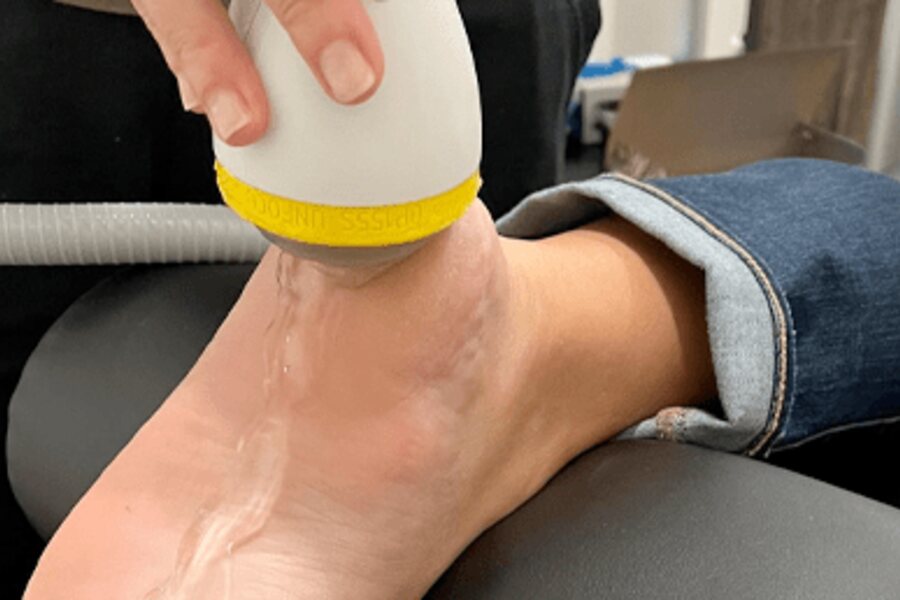
SoftWave TRT takes aim at the two problems at the heart of chronic tendinopathy: poor blood supply and stalled tissue repair. It uses electrohydraulic, spark-generated broad-focused acoustic waves delivered through a patented parabolic reflector. That broad-focused design allows the energy to spread through a meaningful volume of tissue and reach deep structures, rather than concentrating on a single narrow point. The waves act as a mechanical signal designed to wake up the body's own healing cascade in tissue that has gone quiet. In plain language, here is what SoftWave is designed to encourage:
- Angiogenesis. The therapy is designed to stimulate the growth of new blood vessels, which may improve circulation to a tendon that has struggled with limited blood supply for years.
- Resident stem cell activation. The acoustic waves are intended to activate and mobilize the body's own repair cells so they migrate toward the injured area.
- Collagen production and cell proliferation. By supporting the creation of new collagen, SoftWave may help the body lay down healthier, better organized tendon tissue over time.
- Modulation of inflammation. The therapy is designed to help regulate the local inflammatory environment so repair can proceed.
- Clearance of damaged cells. Part of healthy repair is removing worn out and senescent cells so fresh tissue can take their place.
The important idea is that SoftWave does not simply mask pain. It is designed to address the mechanical and biological reasons a chronic tendon stopped healing, which is precisely what makes tendinopathy so stubborn in the first place.
What the Experience Is Like at Shockwave Maui
One reason patients appreciate this option is how straightforward it is. SoftWave therapy is non-invasive. There are no needles, no drugs, no surgery, and no downtime afterward, so you can walk out and go about your day on Maui. Sessions are short, generally ten to fifteen minutes. Most people work through a series of visits over roughly six to eight weeks, since rebuilding tendon tissue is a gradual biological process rather than an overnight fix. It is also worth knowing that the healing response is designed to continue for weeks and even months after your final session, as the body keeps responding to the stimulus.
If a tendon issue has been slowing you down for months, this is a good moment to have it evaluated rather than continuing to wait it out. Schedule your SoftWave consultation with Dr. 808 in Kihei and get a clear picture of what is really going on.
Setting Realistic Expectations
Chronic tendinopathy took time to develop, and it takes time to reverse. SoftWave is not a guarantee of a cure, and it is not a replacement for a proper evaluation or for any medical care your situation may require. What it offers is a non-invasive way to support your body's natural repair mechanisms in tissue that has been reluctant to heal. Many patients report meaningful improvement in comfort and function as they progress through a series. During your visit, Dr. 808 can assess whether your tendon pain is still acute or has shifted into the chronic, degenerative pattern, and tailor a plan accordingly.
Ready to Take the Next Step?
You do not have to accept lingering tendon pain as your new normal or keep sidelining the activities you love here on Maui. If your tendinitis has turned into a stubborn, months long problem, SoftWave therapy may offer the support your body has been missing.
Request your SoftWave Therapy new patient visit online today
Contact Shockwave Maui
Shockwave Maui
2395 S Kihei Rd #202
Kihei, HI 96753
Phone: (808) 875-4357
Our Main Office Website: https://southmauichiropractic.biz/
‹ Back




 2395 S Kihei Rd #202, Kihei